What should you do with the long-forgotten clothes cluttering your closet? How do you stay stylish without buying new outfits all the time? Why are your clothes falling apart after a few washes?
Assistant Professor Colleen Pokorny in OSU’s College of Business researches how sustainability trends affect apparel design and development, with recent publications focusing on designers “upcycling” quilts into wearable garments. After working as a technical designer in the fashion industry for several years, she’s got an inside perspective on the construction and quality of modern clothing.
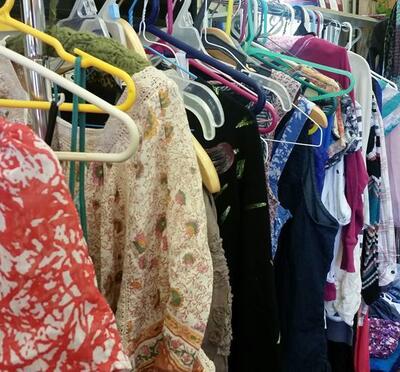
According to the Global Fashion Agenda, 92 million tons of textile waste is produced globally every year. Textile production contributes heavily to global greenhouse gas emissions, and increasingly ubiquitous synthetic materials add to microplastic pollution when those garments break down.
Pokorny has some practical tips for those who want to minimize textile waste.
Q: How do we move away from thinking that clothing is disposable?
“How we got here was the industrial revolution when we figured out how to make things faster and make them for the mass market as opposed to customized clothing,” Pokorny said. “Historically, textiles were prized and considered a form of currency because of the labor it took to make them. But as soon as we mechanized it, we sort of lost the value of our textiles.”
One way to unlearn that mindset, she said, is to remember the labor behind our clothes. In a supply chain that includes farmers who grow the fibers (for clothing made of natural fibers), designers who develop the products and factory workers who dye, cut and sew the fabric, it takes thousands of hands to get a garment to a consumer — and when it sells for just $3, no one in that chain is making money, she said.
Not only does the pricing structure depend on low wages for textile workers; it also means poor construction, Pokorny said. “Consumers are conditioned to think that cheaper is better, but a cheap item that doesn’t fit you is not going to hold up to wear and tear.”
Instead, she said, shoppers should consider saving up for fewer items of higher quality that fit them well and last for many years, and resist buying low-cost garments that fall apart and will need to be replaced.
Q: How do I pick high-quality clothes?
Start by looking at clothing labels. Fiber content will tell you what the clothing is made of: Cotton, wool, linen, silk and other animal fibers are natural fibers, though they are often blended with synthetics like polyester. Pokorny prefers 100% cotton sweaters, if she can find them.
While natural fibers are better than synthetics in terms of the clothing’s life cycle — plastic-based clothing follows a similar trajectory as any other plastic — they still have a high cost in terms of water use, labor abuses and environmental concerns from dyes, Pokorny said. Therefore, the goal should still be to consume less in general.
Bamboo is marketed as a natural fiber, but the process to turn bamboo trees into fabric uses toxic chemicals and has a heavy environmental impact, and the resulting material is usually semi-synthetic.
Q: How can I make my clothes last longer?
Learning how to properly care for your clothes goes a long way, Pokorny said. For instance, wool is naturally odor- and stain-resistant and requires less washing. (Maybe use a little spritz of vodka on the armpits if there’s an odor problem between washes, she added.) Hand-washing (or using the delicate or hand-wash setting on a washing machine) and laying items flat to dry is a safe method for most materials. If using the washing machine, wash on cold, avoid fabric softener and try to use unscented and undyed detergent. Putting clothes in the dryer on high heat will only make them break down faster.
Laundry might take longer, but your clothes will last longer, too, Pokorny said.

Another worthwhile investment is to learn basic sewing and mending. You don’t need a sewing machine; most fixes can be done with a needle and thread, she said. (The OSU Craft Center and Corvallis Community Center both offer mending classes.)
Mending can also be a way to personalize your clothing, using stitching techniques like sashiko or adding unique patches, Pokorny said. “You mend it because you care about it.”
Q: What do I do with clothes I no longer wear?
“Research shows that 80 to 90% of the things that go into a thrift store are never sold,” Pokorny said. Instead, those items end up in the dump, in an incinerator or on a beach somewhere in the developing world. And the labor costs involved in sorting through and disposing of all the clothing consumers dump at stores like Goodwill get passed back on to the consumer, making thrifting more expensive now too.
While there is no perfect solution, there are some better options than thrift stores, Pokorny said. Maybe your garment just needs some mending or modification to become wearable again. If the item is higher quality, find a consignment shop that takes specific items they know are more likely to sell. You can also hold clothing swaps with friends or post on buy-sell groups on Facebook or other marketplaces.
Buying less clothing in the first place will minimize the amount you end up throwing away, Pokorny says.
“Instead of thinking of your garments as disposable, think about what special pieces you can have in your wardrobe that really showcase you as a human and how you want to express yourself,” she said. “Have pieces that can be timeless, that are made from good fabrics and good construction and that you can continuously wear. If your whole wardrobe is trendy, then in six months it’s going to be obsolete.”
If there is a special occasion or an instance where you want a trendy garment, that might mean shopping secondhand, renting a garment or borrowing from a friend, Pokorny said.
“It takes more time, but then you’re not sitting around with things you used once and will never use again,” she said.
Want to learn more? Colleen Pokorny was a guest on episode 203 of the Clotheshorse podcast: “Why clothes fit worse in the fast fashion era.” Her recent OSU lecture on upcycling quilts will also soon be online on the College of Business YouTube channel.