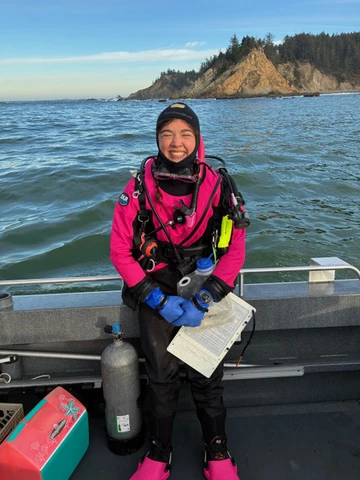
Wave Moretto is a Ph.D. student in the Department of Fisheries, Wildlife and Conservation Sciences in the College of Agriculture Sciences. She just received first place in the Ocean Innovators Award for her work in studying kelp forests
What brought you to Oregon State?
My Ph.D. advisor Scott Heppell. I first met Scott in summer 2022 when I was working on my master’s degree at Scripps Institution of Oceanography at UC San Diego. I was doing very different work then — my master’s was focused on the effect of temperature on box crab, a local fishery species. But my main research interests have always centered around fish, kelp forests and marine conservation, so I was looking for labs where I could study those topics for my Ph.D. Scott does all kinds of research related to marine fisheries, including fish habitat. Ultimately, my decision to go to Oregon State came down to a great advisor, a project that aligned with my research passions, some very cool labmates and friends already living here, and a desire to spend some time in the beautiful Pacific Northwest.
Where did your interest in fisheries science come from?
I grew up near Monterey in California which has a huge history of sardine fishing and canning. I learned about fisheries management (and what happens when fisheries are poorly managed) through that lens from a fairly young age. My undergraduate program was not very fishery-focused, but once I started my master’s, fisheries science became a large part of my thesis research because my study species was an experimental fishery. In San Diego, I got to work directly with box crab fishers and fishery managers at California SeaGrant. I really enjoyed doing science that was directly applicable to fishers, habitat managers and the public, and I knew I wanted to continue down that route.
What makes you passionate about higher education?
I have always been curious, especially about what’s in my own local environment. My parents instilled that curiosity in me and this was magnified when I started my undergraduate degree at UC Santa Cruz. Research and graduate school have been a great way for me to continue to foster this curiosity and answer questions pertinent to marine conservation. In recent years, I’ve been able to teach students through teaching assistantship roles. This has been incredibly rewarding, as I meet students with the same excitement and interest as I had when I first started my research career.
How do kelp forests sustain and protect Oregon fish?
Kelp forests are federally recognized as essential nursery habitat particularly because of their role in supporting juvenile life stages of many different fishes including rockfish, lingcod and even salmon. In Oregon, young rockfish use kelp forest fronds to take shelter from predators and strong currents; they also might have better feeding opportunities within kelp forests. That’s a focus of my Ph.D. research. We see a lot of different adult fish using kelp forests as well. In Oregon, the most common species we see is black rockfish, which is one of the top recreational fishery targets along our coastline.
What are the challenges you face when diving to gather information for your research?
Diving the Oregon coast is not easy. If the swell is too big (generally greater than six-foot seas), it’s not safe to dive or get a small boat on the water. Oregon has intense storms off-and-on from October-March each year, and it’s fairly unpredictable. We can’t schedule field days very far in-advance. Then if it’s not stormy, there’s a good chance you won’t be able to see much underwater. Oregon has intense phytoplankton blooms sporadically from April-September (so the opposite of the stormy season). These blooms can be so dense and block out so much light that visibility is less than one foot. This makes it really hard to count fish, and to do much of anything if you can barely see your own hand. Lastly, when conditions do align, it’s still a struggle to find scientific divers (a special certification), a boat/captain and lodging on short (two to three days) notice. The Oregon coast is very rocky and has a lot of steep cliffs, which means you pretty much have to use a boat to access dive sites — which also drives up costs for conducting research. To address all these issues, I’m chronically checking sea state conditions, have all our dive and sampling gear packed up and ready to go at my house, and have some great contacts for boat captains along the coast. Most importantly, I have some great friends who are generally always keen to dive.
What advice would you give the younger version of yourself who was just starting college?
Stay curious, keep diving and don’t be afraid to pursue the research and career that you’ve always wanted.
What is unique about the way you are gathering information on Oregon kelp forests?
We are the first team to monitor Oregon’s kelp forest fishes year-round. Prior surveys were a day or two out of the year. We go out quarterly to three different sites on the Oregon coast. We are also using a combination of traditional and emergent methods to study fish abundance and diversity. We do underwater visual surveys where I count and identify fish in real time and record them on an underwater datasheet.
At the same time, my dive buddy uses a diver-operated stereo-video camera system to do the same. This technology allows us to measure the total length of fish underwater (the two cameras record fish from two different angles, and we process videos in software that calculates fish length). This allows us to generate biomass estimates for fish in Oregon’s kelp forests.
Lastly, we are using environmental DNA (eDNA) to look at fish community composition. eDNA is any kind of genetic material (waste, scales, gametes) fish naturally shed into the water, so we collect water samples during our surveys. We process these to determine which fish species are present in that water and gain a snapshot of what fish were present at the time of sampling, which really comes in handy when we have low visibility. I just received funding to build up an existing eDNA autonomous sampler to collect, filter, and preserve water samples daily at each of my kelp forest sites for one to two months. This will give us the first continuous biodiversity dataset of fish communities in Oregon’s kelp forests.
What has been your favorite course in college?
I have two favorites, both from UC Santa Cruz. The first is a marine policy class where I learned about how we enforce fishery management and general ocean law. My senior year I took a large marine vertebrates field course. I was able to tag wild elephant seals (these are huge seals, over 1,000 pounds) as part of the class — something I’ll never forget.
What do you hope to do after graduation?
After graduating I plan to complete a post-doctoral position with the ultimate goal of becoming a professor and having my own research lab. I’d like to continue to conduct research centered around kelp forest ecology, fisheries science and marine conservation biology.
What is your favorite nonacademic pursuit or passion?
SCUBA diving. I do this for my research, but I also love to dive for fun. I’m really into underwater photography.
Related Stories