During the first weekend of May, nearly 500 students from across the country gathered at Oregon State University’s Reser Stadium for BeaverHacks, one of OSU’s largest tech events. During BeaverHacks, participants have 24 hours to showcase their coding skills and compete for a variety of prizes.
In addition to OSU students, participants came from the University of Washington, University of Oregon, Stanford and schools across the Midwest and East Coast.
OSU Hackathon Club President Havel Konda has been involved with BeaverHacks for two years. He said the goal of the event is to bridge the gap between the university and industry, allowing students to gain experiences that will directly translate into job opportunities.
“The concepts you learn in class teach you the theory,” Konda said, “but being forced to ship something in 24 hours lets you test your skills and build something you can put on your resume fast.”
NVIDIA, Google, Conductor1, Mark3, and Trimble provided prizes, mentorship, and hands-on support to hackathon participants. During the event, a networking period allowed students to connect with company representatives, and several companies hosted tracks and workshops.
“Tracks are specific challenge guidelines students can opt into,” Konda said. “For example, the NVIDIA track asked students to build a project using Nemotron, their specialized AI model.”
While AI is a tool used in the hackathon, Konda said the expectation is to use it to elevate work, not replace the creativity and ingenuity the event is meant to inspire.
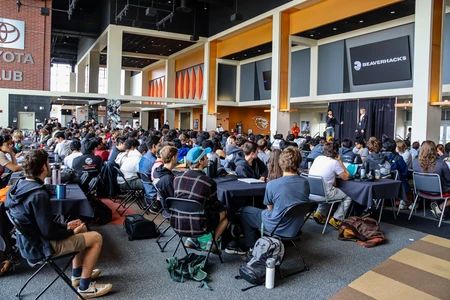
“AI is used to elevate workflows,” he said. “There's a lot of concern about students ‘vibe coding’ entire projects, but honestly, you can tell which projects were built that way. Coding is just one part of the experience. You also need to sell your idea, be creative and do something unique. Students who understand the underlying concepts can use AI as a force multiplier and build far more impressive projects because of it.”
Konda said although BeaverHacks gets support from the College of Engineering and the university, it is fundamentally student-led, which is both exhausting and rewarding.
“These are students who are taking classes and working part-time, sacrificing a lot of time and energy, sometimes even seeing a dip in those other areas of life, to commit everything to this,” Konda said. “None of us get paid, and there's more personal cost than gain sometimes. But when younger students come up to me after the event and say it was a life-changing experience, that they feel more confident in themselves, that's what makes it all worth it.”
The $20,000 prize pool included items ranging from NVIDIA GPUs to drones, AirPods, gift cards and other tech. Below is a list of winning teams by track:
NVIDIA — Best Use of Nemotron: Mocki, PunchHarder, OpenHealth
Google — Best Use of Gemini: Scenerio, Informed Consensus, SPOOT: Sound Point Of Origin Tracker
ConductorOne — Best Agent Infrastructure: Glassbox, Cortex
Social Impact Track: SpeakAbroad, D/SPATCH, Benton County Healthcare Finder
Beginner Track: Guidance, OSU Class Map
Hardware Track: Training Rails, NavigAid
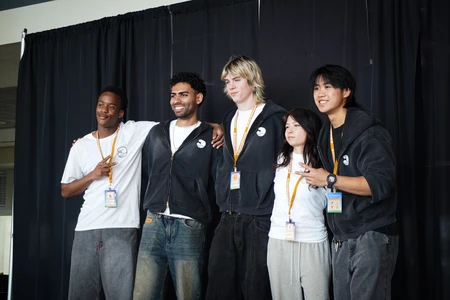
Key partners:
Havel Konda (President)
Owen Krause (Vice President)
Violette Davis (Director of Marketing)
Caleb Chia (Director of Production)
Joshua Chilango (Director of Finance)
Melissa Ward, Steve Niemi and Forrest Masters.
Related Stories