When Chelsea Chao started in OSU’s College of Engineering as a freshman, she didn’t know what she wanted to pursue.
But when she started working with a microbiologist mentor in the Carlson College of Veterinary Medicine, a light bulb went off and she locked in on bioengineering with the goal of working in pharmaceuticals to fight diseases.
“I feel like that research really shaped my whole academic trajectory,” Chao said. “I’m really glad I took that step.”
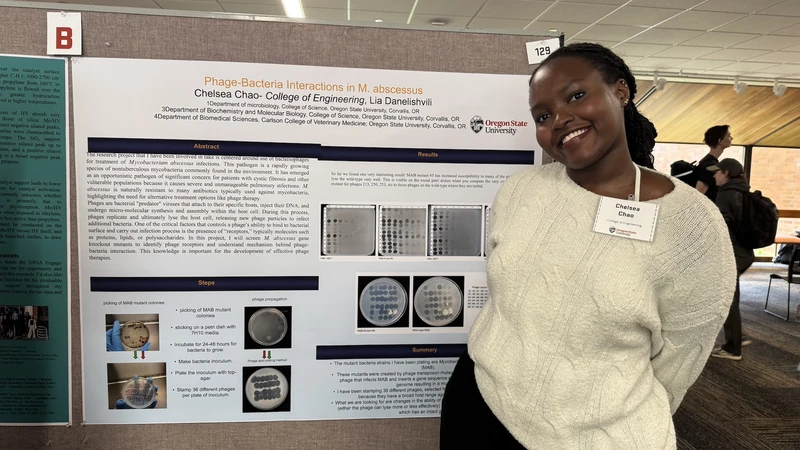
Chao, an international student from Kenya who is now a sophomore, took that step through URSA Engage, a program in the Office of Undergraduate Research that pairs students with faculty for 15-week projects. The program focuses on first-year, second-year and transfer students, giving these early-career students hands-on research experience (URSA stands for Undergraduate Research, Science and the Arts).
Right now, the office is seeking more faculty to apply for the role of mentor. The commitment means taking on at least one student for 15 weeks starting in February, and having check-in meetings with them at least a few times per term.
Interested faculty submit summaries of limited-scope projects connected to their research that students could work on. The deadline for submissions is Sunday, Oct. 12. The program is not limited to STEM fields or academic faculty; professional faculty can also submit projects they want students’ help on.
Interested students submit a form through URSA that goes out to all faculty mentors who have submitted project proposals. Faculty are encouraged to connect with students before the final deadline, and then they select which students they’d like to mentor and invite them to apply to URSA Engage by Dec. 12.
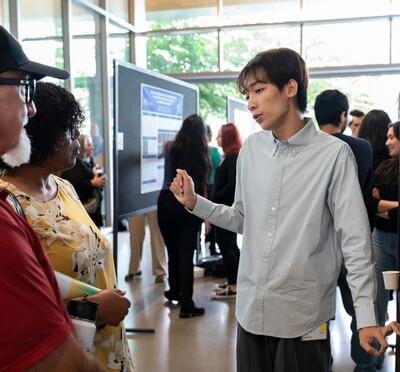
Last year, 836 students reached out to faculty via URSA Engage, and 369 were matched with research projects, said Stephanie Ramos, associate director for the Office of Undergraduate Research. The office works with students who are not matched via Engage to find research homes for them through other avenues, including different programs within the office and by connecting with faculty directly. The finale of the program is the Spring Poster Symposium, where students present their research.
“Undergraduate research excellence is a part of Prosperity Widely Shared and ‘Every student graduates,’” Ramos said. “Our retention numbers for students who do undergraduate research are in the 90s, and almost 60% of them end up in some form of graduate school or post-grad education.”
Research shows that mentorship and experiential learning provide students with valuable real-world skills as well as a sense of connection, she said.
“We know that mentorship increases students’ sense of belonging and engagement. Being in a space with others, sharing and contributing — that makes meaning for students,” Ramos said. “They’re also learning how to communicate, how to problem-solve, how to deal with conflict, how to deal with a lack of funding or a lack of belief in what you do among the general public.”
Connecting one-on-one with faculty also makes it easier down the line when students need letters of recommendation or job references from people who can speak to their abilities, she said.
Swati Patel was a mentor during her second and third years at OSU, taking on two students each time. As an assistant professor of mathematics in the College of Science, her research focuses on coupling ecological and underlying genetic models to understand how evolution impacts species and population dynamics.
Where other responsibilities at OSU might pull faculty away from their core research, URSA Engage gives them an opportunity to dedicate time to research through mentorship, she said.
“Ideally, you are bringing in a student and mentoring them on a research project that you yourself are excited about,” Patel said. “If you’re excited about it, then it will be a rewarding experience to mentor somebody else to think about the same problem.”
Patel said a key factor is identifying a problem that is feasible for an early-career student to tackle, based on their existing skills. And when choosing the project, she sets the students up with work to test new ideas that she is thinking about and wants to explore.
Her first URSA Engage student was so successful that they’ve continued working together, and the student is now writing her Honors College thesis about her work in Patel’s group.
“My advice to faculty members who are going to pursue this is to already have a well-defined, concrete problem,” Patel said. “Fifteen weeks is a short amount of time, so if you can pose a problem right away in the initial meeting, they can get started on it.”
For Chao, working with her mentor Lia Danelishvili not only taught her lab etiquette and set her on her chosen career path, but also helped her build confidence in interacting with faculty.
“It kind of breaks the ice for the students, so faculty seem more approachable and easier to talk to and relate with,” Chao said. “I don’t think most of them realize how impactful they are in students’ lives, but they actually are.”
Related Stories