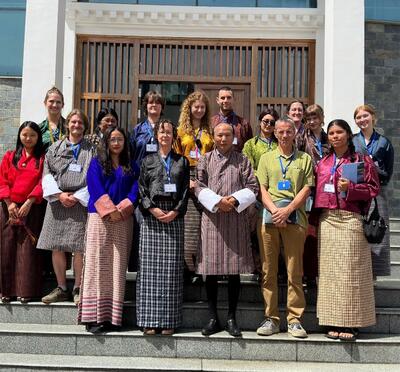
In the remote foothills of the Himalayas, a group of 10 Oregon State University students learned about rural life through the lens of Bhutanese farmers during the university’s first-ever study abroad course in Bhutan this September.

Since the early ’70s, Bhutan has oriented its development around the philosophy of “Gross National Happiness,” a multidimensional approach aiming to achieve “a harmonious balance between material well-being and the spiritual, emotional and cultural needs of society.”
For two weeks, local faculty at the Royal University of Bhutan immersed OSU students in their culture, teaching them about the country’s history, traditions and how Gross National Happiness is applied throughout Bhutanese society. The six-credit course paid special attention to the country’s community-based approaches to natural resource management, sustainable agriculture and traditional conservation.
“The program is relevant for almost any student at OSU, and it’s in a location most students wouldn’t travel to on their own,” said Michele Justice, director of OSU Global Opportunities, which facilitates student participation in international experiences through a diverse set of program offerings. “They have a unique opportunity to compare Bhutanese culture with their own and to grow as global citizens. This sort of experience can lead students to ask some really deep questions on both academic and personal levels.”
A protectorate of India, the mountainous Kingdom of Bhutan is located east of Nepal and south of Tibet, and has a population of only about 800,000. The country has never been colonized, formed its first democratic government in 2008 and is led by both a king and a prime minister.
This joint program with OSU is the very first time RUB has officially partnered with a university outside Bhutan to bring in foreign students and integrate them into Bhutanese life.
It’s also one of the first GO programs to grow out of a collaboration with OSU Extension. The Bhutan connection was born from the longtime friendship between Extension organic vegetable specialist Nick Andrews and his Bhutanese college classmate Doe Doe. Doe Doe introduced Andrews to agriculture professor Sonam Tashi at RUB, and in 2016 Andrews and another Extension colleague from OSU’s Center for Resilient Agriculture visited Bhutan to help Tashi and the College of Natural Resources build the curriculum for a degree in organic agriculture.
“We’d been trying to develop a partnership around Extension work, direct work with farmers and applied research,” Andrews said. “Sonam asked me if any OSU students wanted to do study abroad, and we decided that instead of sending OSU students ad hoc, we’d set up a formal program through OSU GO.”
Those Extension origins inform the structure of the program, which is focused on hands-on fieldwork where students interact directly with local stakeholders and community members, aligning with Extension’s relationship-building and knowledge-sharing work in Oregon. Students also spent a few days living with farming families in their homes, milking cows, harvesting vegetables and learning to cook Bhutanese food while observing the interconnectedness of Bhutanese farming, livelihoods and nature.

That level of access is very rare in Bhutan, as the country applies a $100 daily fee to outside travelers and requires tourists to have a guide if they want to roam outside the capital city, said Mary Halbeib, who went on the trip as a faculty chaperone and helped plan the curriculum as a professor of practice in OSU’s College of Agricultural Sciences. CAS academic advisor Stefan Seiter was also on the trip and part of the planning team.
Unlike most OSU GO short-term study abroad programs, the Bhutan course is taught exclusively by local Bhutan faculty. In Bhutan, all formal education is conducted in English, so there was no language barrier for OSU students.
In building the program, the OSU team and RUB faculty met remotely every month for a year to plan the curriculum, farm stays and field activities, Justice said.
“It’s one of the most rewarding partnerships we’ve been a part of — they’re just amazingly dedicated to student learning and sharing their culture and history,” she said. “The proposals they put out as opportunities for learning were some of the best I’ve ever seen. They had such a command of what would be interesting, useful and engaging for students and how to teach that.”
Senior Sarah Lynch, who’s getting her bachelor’s degree in agriculture with a minor in horticulture, was intrigued by the program’s emphasis on contentedness and being more present in daily life. During the trip, she said she was struck by how peaceful everything was and how the Bhutanese people were in harmony with the local environment, instead of seeking to dominate it for their own purposes.
“It really drives home the desire to work more with Mother Nature, without removing the weeds, clearing trees and exposing the ground,” she said. “I know that I would like to focus more on sustainable development, and on learning to be happy with what is already present without worrying about things that I cannot control.”
On both the OSU and RUB sides, plans to continue the program are already underway.
“We are interested in continuing the summer school program with OSU students, not only once a year, but twice if possible,” Tashi said via email from Bhutan. “Besides the summer school programs, we are interested in student/faculty exchange, joint research and publication, joint programs/degree, joint teaching and co-hosting conferences here, among other activities.”
While the small group this year made for a great first trip, Halbleib hopes many more students take advantage of the opportunity to visit such a unique country.
“The Bhutanese fully recognize that everything is interconnected,” she said. "Their norm of sharing whatever they have to help others left me in awe of their kindness and generosity.”